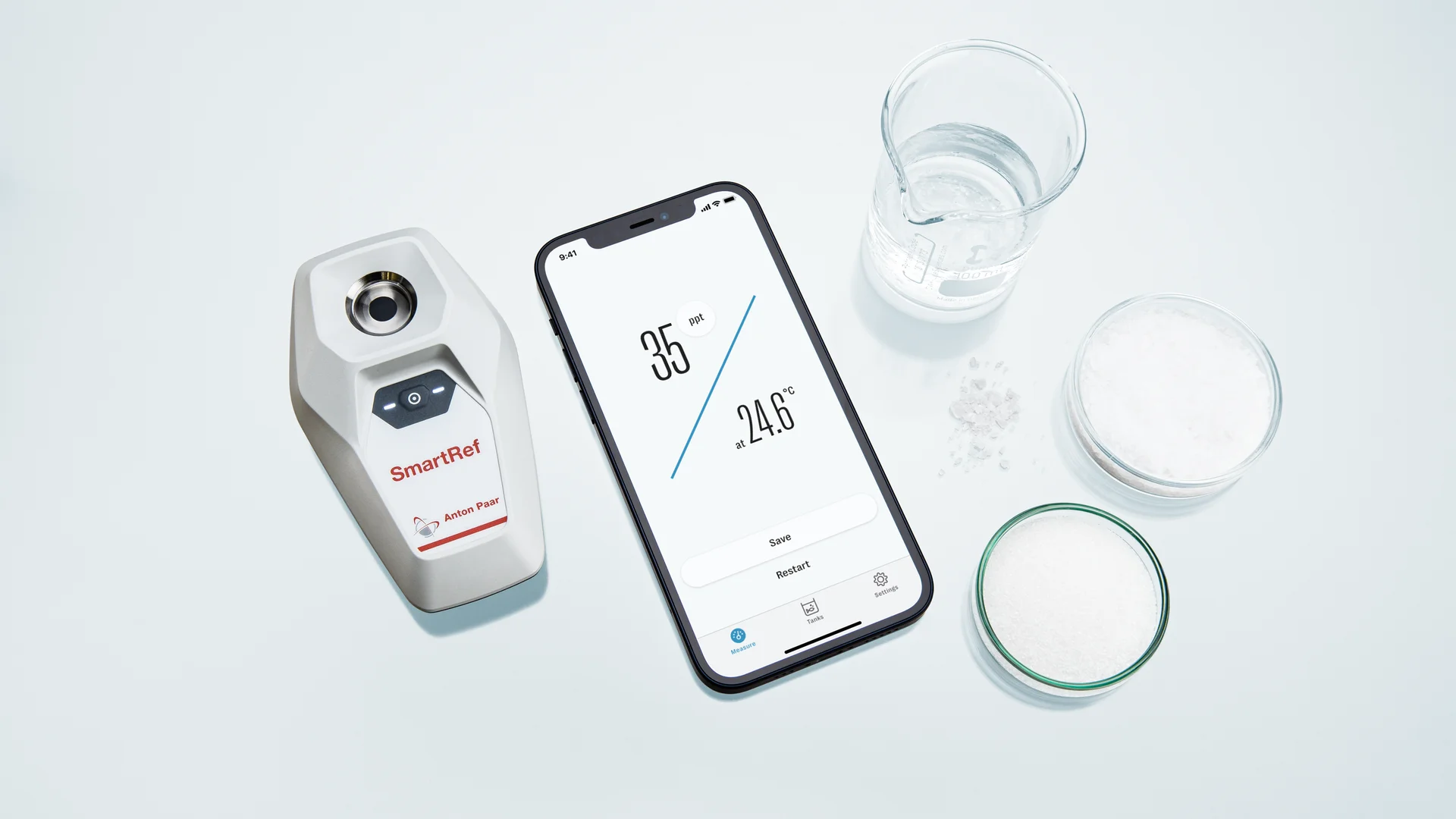
Handheld Density Meter Accuracy: 5 Causes of Bad Readings
Written by Mandi Noel with field expertise from co-author Alex Ganni, VP of Production Line Support, RSS MACLIN · October 2, 2026
When a handheld density meter gives a bad number, the meter is rarely the problem. Handheld density meter accuracy depends on the sample and the routine: gas left in the measuring tube, a cell still coated from the last sample, an alcohol sample that sat too long, solids in the sample, or a reading taken before it settled. Each one has a simple check and a simple fix.
Why Handheld Density Meter Accuracy Slips
Most handheld density meters measure the sample inside a small glass U-tube. The meter reads whatever is in that tube, so anything that is not your product (a gas bubble, residue, a particle) becomes part of the reading. Gas throws off every handheld unit, not only density meters. A bubble on a refractometer's lens or a pH sensor skews that reading too. In a density meter the problem is worse, because the closed tube traps the gas instead of letting it escape.
The result on the floor is familiar to anyone who runs spot checks on beverages, dairy, coffee, sauces, brines or vinegars. Two loads of the same sample disagree, or a batch that is fine reads out of spec, and the team starts to distrust the tool.
How to tell a reading is off
Start every shift with a water check. Distilled water should read a specific gravity of 1.000. If it doesn't, the cell is dirty or the tube is not full, and every reading after it will be off by the same error. Tap water will often read close to 1.000, but use distilled water for the check so a mineral reading never hides a dirty cell.
The second check is repeatability. Load the same sample twice. If the two readings don't agree, look at bubbles and sample preparation before you look at the meter.
Root causes of bad readings
1. Gas bubbles in the U-tube
This is the most common cause, and it hits carbonated products hardest. Degas the sample before every reading, whether the unit measures density, Brix or pH.
In a density meter, a bubble leaves a gap in the sample volume, and the meter reads the gap. Shaking the sample hard in the syringe drives the gas out of a small sample quickly. Pushing the sample through until liquid shows on both sides of the tube clears what is left. Pulling the syringe or the outlet tube off after filling pulls air back in, so leave both in place until the reading is done.
2. A dirty measuring cell
Sticky product such as syrup, beer or salt solutions leaves a film if the cell isn't rinsed after the last sample. The next reading starts from that film. The water check catches it. To clean, draw hot water with a little dish soap into the syringe, push it back and forth through the tube to scrub the glass, then rinse with clean water and check again.
3. Alcohol samples that sit or separate
Alcohol evaporates from a small sample, so the alcohol reading keeps dropping the longer the sample sits in the cell. Alcohol also stratifies in its container, so the top of a sample is not the same as the bottom. Mix the sample by shaking it in its container or the syringe before you load it, then read it as soon as it is in the tube.
4. Solids and complex samples
Particles lodge in the narrow glass tube and throw off the reading until they are flushed out. Filter any sample with visible solids before it goes in. Sample makeup matters too. A density reading alone works well on a two-part solution such as sugar and water or alcohol and water. Products with three or more parts (sugars, flavors and alcohol together) need a second measurement, such as refractive index, to get alcohol by volume. Some high-sugar distilled products also need a correction factor for that product.
5. Taking the reading before it settles
Many meters have a live or continuous display mode that keeps updating. In that mode there is no clear point when the reading is final, so two people can record two different numbers from the same load. Set the meter to its single stable-reading mode for QC checks, and write that setting into the procedure so every shift reads the same way.
Prevention: a sample routine that holds up
The fixes above come down to one routine. Use these steps for every carbonated or alcohol sample, on any handheld unit:
- Run the distilled-water check at the start of the shift and confirm 1.000.
- Filter the sample if you can see solids in it.
- Shake the sample in the syringe to drive out gas and mix it, then push out the trapped gas with the tip pointed up.
- Load the sample until liquid shows on both sides of the U-tube, and leave the syringe and outlet tube in place.
- Tap the meter and look for bubbles in the tube before you start.
- Take the reading in stable-reading mode right away, and save it.
- Rinse the cell with water after the last sample, and clean it with hot soapy water if the water check fails.
Handheld meters are built for fast spot checks on the floor, not to replace a lab instrument. Smaller breweries often run daily readings on a handheld meter and keep a calibrated reference hydrometer on site for official checks. The small sample also helps on hot product. You cool a few millilitres instead of a full hydrometer jar.
The glass tube is also the fragile part. A dropped density meter usually means a replacement, not a repair, so keep it in a protective case, especially when people are handling it in lab gloves.
From the Field
Alex Ganni ran a handheld digital refractometer and a handheld pH meter during a site visit at a co-packer, checking Brix and pH on product from the line. Neither one has the closed tube of a density meter, and gas still threw off his readings. His first readings on carbonated product moved more than they should have.
"Bubbles on the lens changed the Brix reading a lot." Alex Ganni, VP of Production Line Support, RSS MACLIN
He was already degassing. "I was shaking it hard in the syringe to get the bubbles out," he said, then tapping the unit to check for more. What was left was the display. The meter was in continuous mode, so he couldn't tell when the reading was final. Switching to the stable-reading mode gave him one recorded number per load, and the degassing routine above kept those numbers repeatable.
Key Takeaways
Run a distilled-water check before each shift, and clean the cell if it doesn't read 1.000. Degas and mix every carbonated or alcohol sample, keep the syringe and tube in place while you measure, and read alcohol samples right away. Filter out solids, use a second measurement for products with three or more parts, and set the meter to stable-reading mode in the written procedure.
When the Reading Is Still Wrong
Sometimes the meter and the sample routine are fine, and the number is right: the product coming off the line is out of spec. RSS MACLIN technicians diagnose the production machines, the product itself, the line equipment and the QC instruments used to check it. That lets us trace a bad number back to its real cause, whether that is the meter, the sample routine or the process.
We also supply handheld density, Brix and pH meters, and our technical training covers the operators and maintenance teams who run these checks. To add handheld QC checks on your floor, send a parts and equipment request or call 330-299-8210. Breweries can also see Breweries and Alternative Beverages.
Related Articles
Making Sure Your Product Stays True from Production to the Shelf
Written by Mandi Noel with field expertise from co-author Alex Ganni, VP of Production Lin…
The One Gauge Every QA Team Should Keep Handy
Written by Mandi Noel with field expertise from co-author Alex Ganni, VP of Production Lin…